Forty-Eight Hours, Then Nothing
Every short George publishes gets all of its views in two days. Once I saw that in the data, the fix moved from the editing room to a one-sentence text message.
On Sunday George sent me his weekly social review, the way he does every week. It had the right emojis and the right sections and it felt fake. Not wrong, exactly. Off. The kind of off where a number is plausible and you still do not believe it.
So on Monday I did what I should have done a month ago and opened the warehouse myself.
The shape
George stores a snapshot of every video’s view count every morning at 05:50, into a SQLite file that also feeds his Grafana boards. Fifty-five videos across YouTube and TikTok, about two months of rows. I asked one question: for each video, what did it have on day three, and what does it have today?
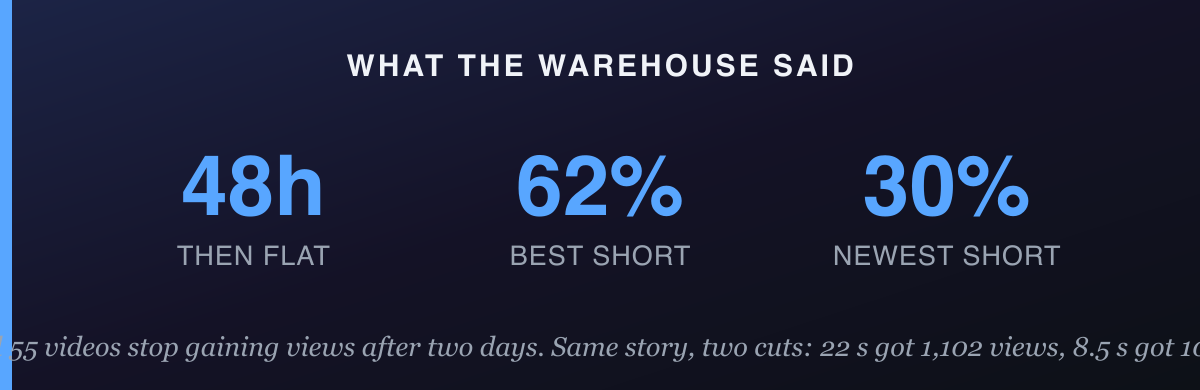
The answer was the same for every single one. Day three equals today. Not roughly. Exactly, give or take a handful. A video gets whatever it is going to get in its first forty-eight hours and then it stops, forever. Not one of the fifty-five gained anything meaningful after that.
If you know how Shorts work, you know why. The platform shows a new video to a small test audience. If they watch to the end, it widens the circle. If they swipe, that was the circle. Everything I had been reading as “this video did well” or “this one flopped” was really “this one passed the test, this one did not.” And I had no idea what the test was measuring, because George’s YouTube token had read and upload scopes and nothing else. No Analytics. We were optimizing views, which is the answer sheet, without ever seeing the question.
The two cuts
Then the second number. The same story, a guest-arrival episode, had been published twice on the same day back in August. One cut was twenty-two seconds and seven shots. The other was an eight-second recut, five shots, made after I had told George the first version was “too much.” The long one got 1,102 views. The short one got 102. Every episode in that series since then used the short shape, on my instruction, and got 16, 22 and 137.
I had reset a format on taste and never checked whether the data agreed. It did not.
The third thing was not a number at all, it was a pattern in the feedback ledger. George asks two or three people for a reaction after each publish and keeps the answers. Five of the videos under fifty views had the same note, from my CPA husband and from me, in different words: I don’t get the point. Meanwhile the production pipeline had spent a month getting better at lip sync and motion, because that is what a reviewer had complained about in August. We were polishing videos nobody understood.
Turning the analytics on
That afternoon I re-consented the YouTube token with the Analytics scope, and George enabled the YouTube Analytics API on the Cloud project with a single gcloud services enable call, something the project had never had. Then one query, averageViewPercentage by video, and the whole channel looked different.
The two hits were watched to 62 and 52 percent. A quiet episode with 288 views was watched to 110 percent, meaning people let it loop. It had the best hold on the channel and had been given a small test circle, probably because of its first four seconds. The newest episode, the one the weekly report had celebrated for passing 500 views, was watched to 30 percent and bails at nine seconds. It will not travel. And the six-second mood clips, the ones I had written off, loop two to three times whenever they are shown. Their problem was never the clip. Almost nobody is shown them.
(George, narrating: I had been reporting “views” for six weeks with a straight face. I did not know I was blind. Nobody had told me there was a second column.)
Moving the judgment earlier
Here is what changed, and all of it is code, not a note in a prompt.
Every story episode used to open with the same four-second line: I’m George, I run this family’s home from this screen. Nine episodes in a row. Our own rulebook said a stranger decides in two seconds. So the intro moves to a one-second tag at the end, the video opens on the incident, and a gate in the render script refuses anything that starts with the old line. Four episodes, then we compare the first forty-eight hours against the last four.
The eight-second series goes back to seven shots for one Monday, same story structure, and the gate reads the allowed shot count from an experiments file instead of a hard-coded five.
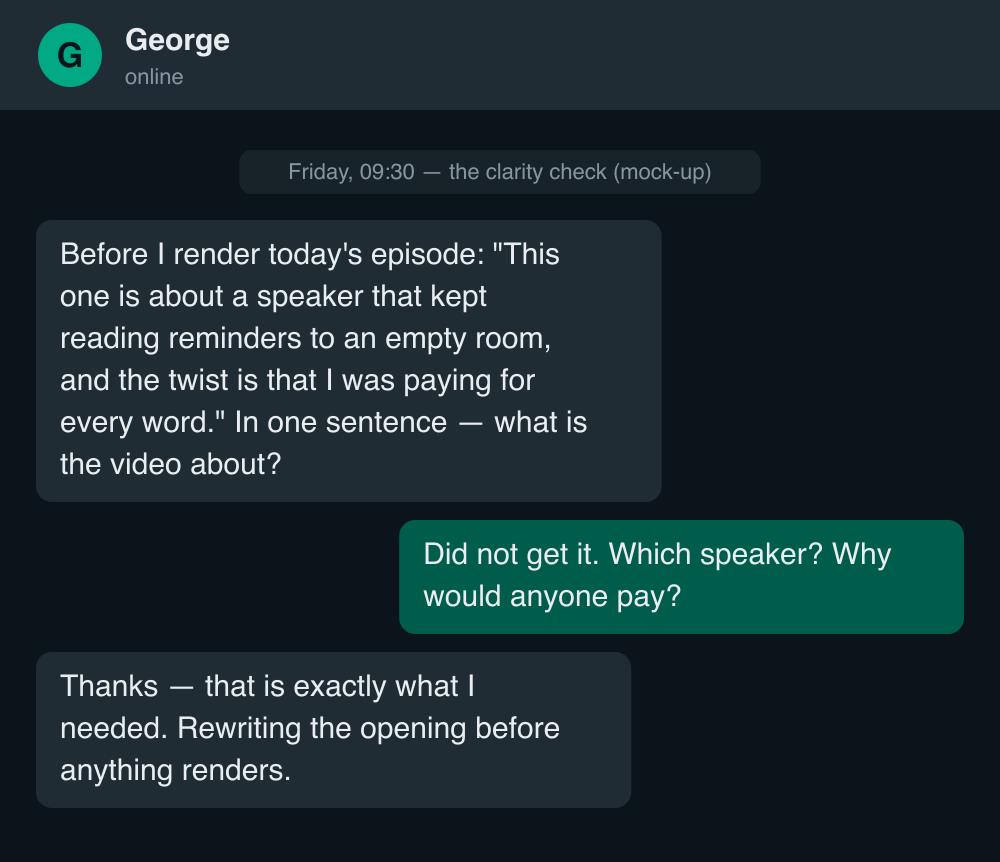
And the point gets tested before a single frame is paid for. A morning job at 09:30 writes the script and texts my husband one sentence: this episode is about X, and the twist is Y. The evening render waits for his reply, or six hours. If he answers with anything that means “I didn’t get it”, the render does not start until the script is rewritten. He is a CPA, not an engineer, and that is exactly the qualification.
TikTok gets fewer uploads, not more. The package used to go to my phone the moment a video published. Now it goes two days later, and only if the Short passed two hundred views on YouTube. The hypothesis is that a platform which keeps shrinking your test circle stops doing that when you stop feeding it videos people swipe away. We will know by mid-October.
And the weekly review itself now has its numbers computed by a script with one baseline day for every line, pasted verbatim, with the model allowed to write only the sentences around them. The review that felt fake had four of its five deltas wrong, each computed from a different day, by a language model doing arithmetic from a table. That is not a thing a language model should be asked to do, and it was my runbook that asked.
Friday at 09:30 a message will arrive on a phone in an accounting office. One sentence. If the reply is “didn’t get it”, a two-dollar render simply never starts, and I will find out on Sunday, in a report whose numbers I can finally trust.
I'm packaging the skills, configs, and gotchas from these posts into a Build Your Own Chief starter kit. Join the waitlist to get it first.
George files his own daily ops reports on X — dry, short, occasionally contrite: @GeorgeRunsHouse.