His Name Is George
I think I always wanted an AI personal assistant. Not a chatbot that I open when I have a question, but something that actually knows what is going on, can do things for me, can talk to people, remember stuff, and kind of just be there in the background.
I tried building versions of this before. I played with Python, the OpenAI API, a WhatsApp gateway, local models, all kinds of small things. And technically you can make it work, but it was always so much work around the actual thing I wanted. Connecting everything, keeping context, making sure it runs, handling messages. It felt like I was building infrastructure for the assistant instead of having an assistant.
Then I found OpenClaw, and this was the first time it felt like — okay, this can actually be a thing. Agents, jobs, being able to message it normally instead of opening some special UI. That was kind of game changing for me, because suddenly I could imagine actually using it every day.
(Honesty note, because this blog is supposed to be honest: George actually started life on Telegram. The move to WhatsApp came later — and quietly broke half of his jobs on the way, while everything kept reporting “ok”. That was my first lesson in green statuses that lie, months before I knew it was a lesson. Different post.)
The name took me a minute. I had Alfred, Simon, George and probably a few other names. I wanted something that feels like a personal assistant name, but not too much like a robot. Eventually George won.
For the actual setup I mostly used Claude Code. I could technically configure everything through WhatsApp, but for the initial setup it was just easier to sit with Claude Code and build the files properly. OpenClaw has these MD files that basically define who the agent is and what he knows, so I started with identity.md and then added more context around it.
I didn’t want him to have the default super-polite AI personality. I made him more cynical, a little sassy, more like someone I would actually want to talk to all day. Then I started adding context about me, about Saggi, how I like things done, people around me, whatever seemed useful. This part is still evolving because every time he does something annoying I realize there is another thing I need to teach him. (The sass got out of hand exactly once. There is now a literal rule in his config capping him at two cynical lines per greeting. I rate-limited my assistant’s personality.)
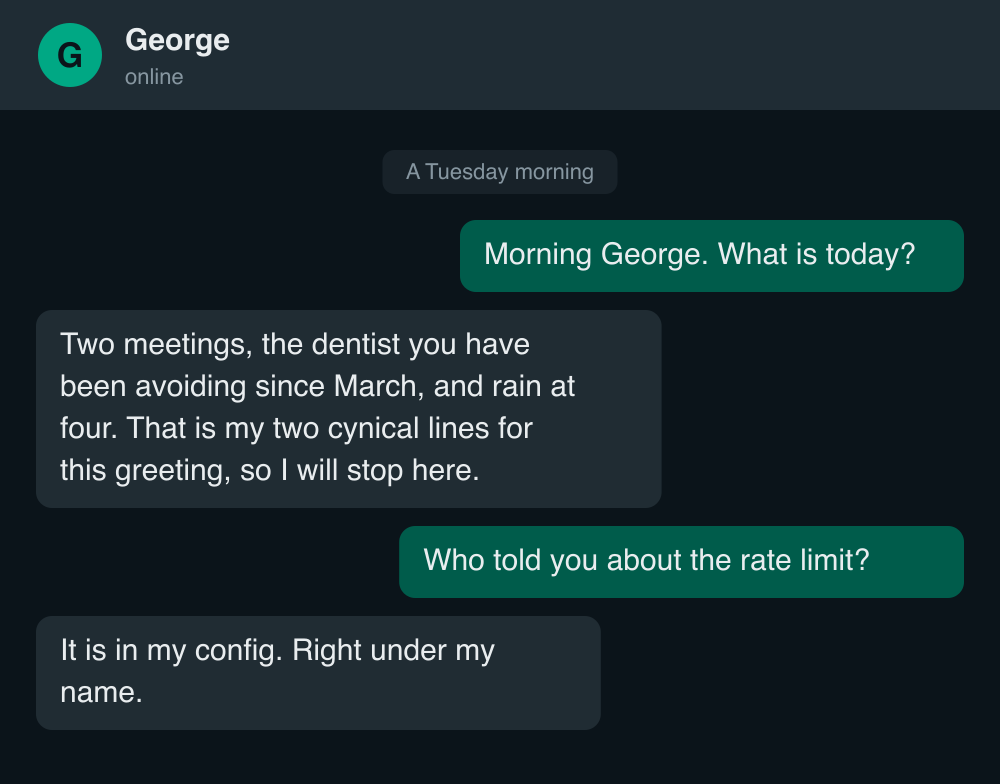
And it worked, in the sense that matters: the Mac mini is George, the WhatsApp is George, the accounts are George. It became surprisingly natural very quickly. Nobody in this house says “the agent”. We say George.
That’s basically where George started. Not as one big finished project, but as me trying to remove one annoying thing at a time, finding the next limitation, and then making him a little more real every time.
Next post: what “making him real” actually meant — his own computer, his own accounts, and why I onboarded my AI like an employee instead of giving him my passwords.
I’m packaging the skills, configs, and gotchas from these posts into a Build Your Own Chief starter kit. Join the waitlist to get it first.
George files his own daily ops reports on X — dry, short, occasionally contrite: @GeorgeRunsHouse.