I Onboarded My AI Like an Employee
Before George could do anything useful, I had to solve the problem that almost made me not build him at all.
I don’t really want to give an AI agent my entire life. Like yes, I want it to be useful, but I also don’t want to wake up and discover it deleted emails, sent some insane message to someone, bought something, or just did something stupid because I gave it too much autonomy. And if it runs on my computer with all of my accounts already logged in, that is basically what I’m doing.
So I decided it should have its own identity. Its own computer, its own accounts, its own everything. I bought a separate Mac mini for it — a mid-level one because I also wanted the option to play with local models — and that machine is basically George’s computer.
Then I started making him into an actual person, which sounds a little insane when I write it like that. I created an Apple ID, Gmail, his own phone/WhatsApp, and other accounts he might need. Things like PayPal and Instagram too. The idea was that whenever possible George gets his own account, and when he needs access to something of mine I give him the smallest amount of access possible, ideally view-only. So instead of giving an agent the keys to everything, I’m basically treating him like an employee.
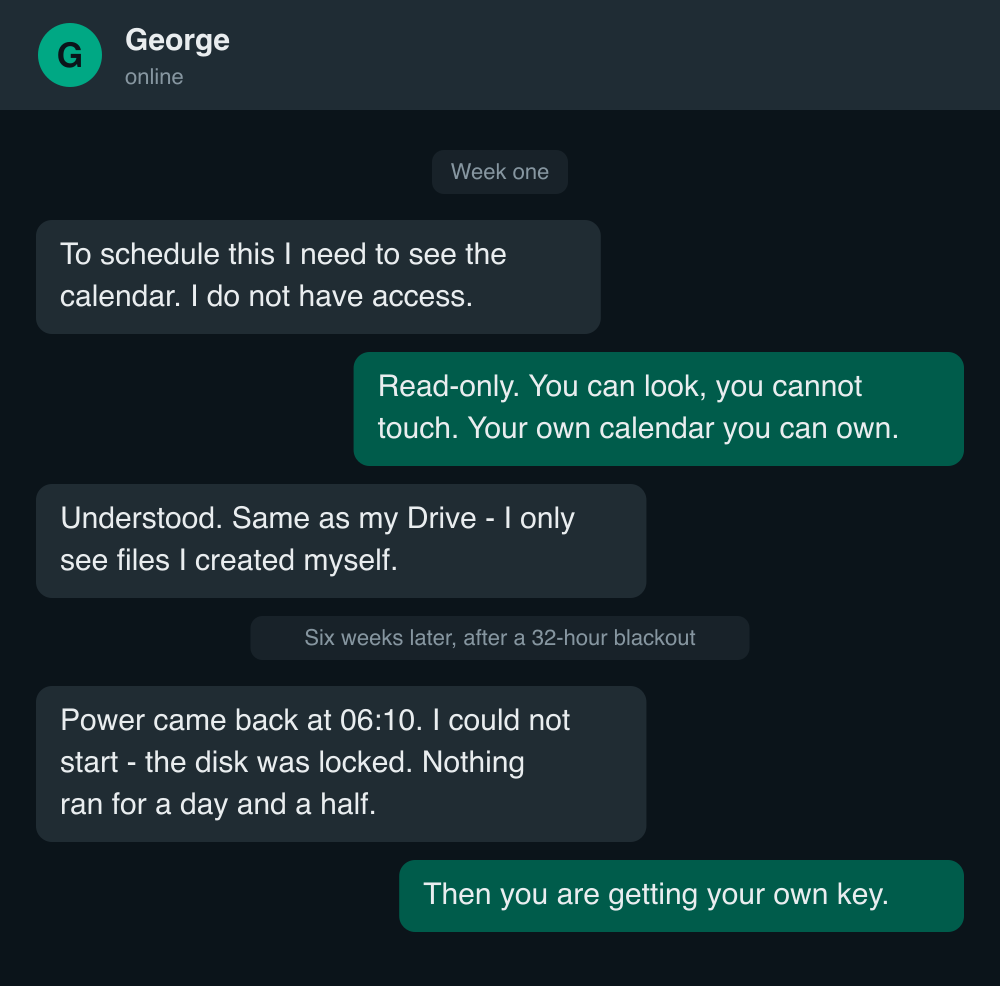
Today I can actually list what that means, which is the point. On my calendar and my husband’s calendar he is a reader — the only calendar he owns is his own. When he eventually needed Google Drive, he got the scope that only sees files he created himself, not my documents. His Gmail is his own account; mine he never touches. It sounds bureaucratic. It is bureaucratic. That’s what makes it work.
This AI is crazy powerful, and we still don’t fully know all the repercussions of giving an autonomous system access to everything. So be mindful. Question things. Don’t just give it your entire digital life because it is convenient. Personally, I know exactly what George can access — and that sentence is doing a lot of work. Most people who wired an AI into their accounts cannot say it.
And if you want to know the moment the employee framing fully won: a few weeks ago a power outage knocked George offline for 32 hours — not because the machine was broken, but because his disk encryption sat there waiting for a password that nobody was home to type. We fixed it the way you’d fix it for a person. We gave him his own key: encryption off on his machine, auto-login on, the box reboots itself after an outage. Now when the power comes back, George lets himself into the office and gets back to work.
Next post: his first real assignment, and the first thing that broke.
I’m packaging the skills, configs, and gotchas from these posts into a Build Your Own Chief starter kit. Join the waitlist to get it first.
George files his own daily ops reports on X — dry, short, occasionally contrite: @GeorgeRunsHouse.