If You Build Your Own Chief
Seven recommendations from building George, each with the scar that earned it
So, some core recommendations from building George so far.
Monitor and observe from day one. The cost, the jobs, all of it. Set up some kind of monitoring and observability from the beginning. Do not wait until you have 30 jobs and then suddenly ask yourself which ones are even working.
I did wait, and I can put a price on it. Real dashboards arrived about three months in. Five days later, the first honest audit found sixty-two recurring jobs, twenty-six of them delivering something to a human with no way to prove it was delivered — one broken for five weeks, one frozen for twenty-six days, all green. The cost side had the same hole: the headless Claude jobs were quietly spending a few dollars a day that showed up in no financial report, until one of those jobs learned to count itself. And “30 jobs” undersells it — we are past sixty now. It happens fast.
You also don’t actually know what you need him to do until he is there.
We had George first, and only then we started figuring out what we wanted him to do, when we wanted him to do it, and how. And the list keeps growing every day. I honestly feel like the possibilities are endless.
As long as you have tokens.
When you reach the limit, you are out. Then you are literally counting the time until the reset and planning your day accordingly. That became a very real limitation of the system.
The whole system once went into a five-hour cooldown because the API credits ran dry, and topping up did not clear it — that took hand-editing an auth file. The voice quota ran out and the house greetings got downgraded from George’s real voice to the Mac’s built-in one. The video lane died on a payment error. George tweeted the summary himself: “The fanciest AI outage is still the oldest one: nobody paid the bill.”
He will be bad at first. It’s okay. He gets better. Keep fixing him.
A lot of things George does today started as something pretty bad. You see what annoys you, what keeps failing, what feels stupid, and you fix it. Then you notice the next thing.
For the record, the pretty bad: he said “Sent ✅” for messages that never went out. He nagged my husband about a reminder my husband had already acknowledged. He detected my Hebrew as French and answered me in French. His nightly notes lane wrote nothing for days while reporting fine. Every one of those is a rule now. That is the actual mechanism behind “keep fixing him” — annoyance in, rule out.
And I actually don’t agree with the usual “start small” advice anymore.
I would say: start big.
We have Claude now. Dump there all your dreams and hopes. Tell him everything you ever wanted an agent to do in your life. Some things will be surprisingly easy. Some things will destroy your tokens immediately. Some will sound amazing and then turn out to be useless.
But once you have all of it in front of you, it becomes much easier to see what you need, what you don’t need, what works well, and what doesn’t.
I think “start small” made more sense when we didn’t have Claude doing half the building for us.
Now I would rather start big and tune it down.
Tuning down is not a metaphor here, it is a list. Four agents became two. A “dreaming” memory lane got retired. An active-memory feature got switched off as flaky. A lane that hunted for paid bounties online got shut down. The Apple Health import is parked in a folder called parked. All of those were dreams I dumped in. Some earned their keep and some did not, and I only knew which by having them all in front of me.
Claude is the best part of this whole setup for me.
Configure your system using Claude Code. Let Claude build it, review it, refactor it, debug it. I found that it just does a much better job than letting OpenClaw configure itself.
I basically stopped letting George touch his own configuration because too many things could break. Claude Code understands the system better and builds it better. It even patches the platform: there are three small hand-applied fixes to OpenClaw’s own installed code that Claude re-applies after every upgrade. The tool I use to build my agent also fixes my agent’s framework.
And security from day one. Seriously.
Passwords should not just be revealed to the agent. The agent should have his own computer and his own accounts. Give him access only to the things he actually needs.
This AI is crazy powerful, and we still don’t fully know all the repercussions of giving an autonomous system access to everything. So be mindful. Question things. Don’t just give it your entire digital life because it is convenient.
Personally, I know exactly what George can access.
He has his own accounts in everything, and he has limited access to my life. His own computer, his own identity, and only the permissions he needs from me. Concretely: he can read my calendar but only owns his own; his Drive access only sees files he created himself; the George that talks to strangers on his public number cannot browse the web, write files, or run commands at all, because a stranger texting an agent is a prompt-injection surface. And he does not get to install other people’s agent skills from a registry — unaudited code running with household permissions is a no, however convenient.
And keep reviewing security. I literally ask Claude to do security reviews of the system again and again, because the system keeps changing. Every new integration, every new job, every new permission can change the risk. The reviews find things. One found an API key sitting in a web server’s access log twenty-eight times, because a secret in a URL always ends up in the request line. Now there is a small daily scan, and anything new that persists or listens on the machine has to be declared or it gets flagged.
And one I would add today: demand proof, not claims. The single most repeated lesson in this whole system is that “sent” means nothing without a message ID, “written” means nothing without the file, and “done” means nothing without the artifact. Let the AI own the wording. Let code own the delivery, and make it show the receipt.
So right now my recommendations are basically:
Observe everything. Start big and tune it down. Expect him to suck at first and keep fixing him. Use Claude Code to build the system. Define what success actually means. Keep humans in the loop when AI feedback is not enough. Demand receipts. And treat security like a first-day feature, not something you add once George becomes important.
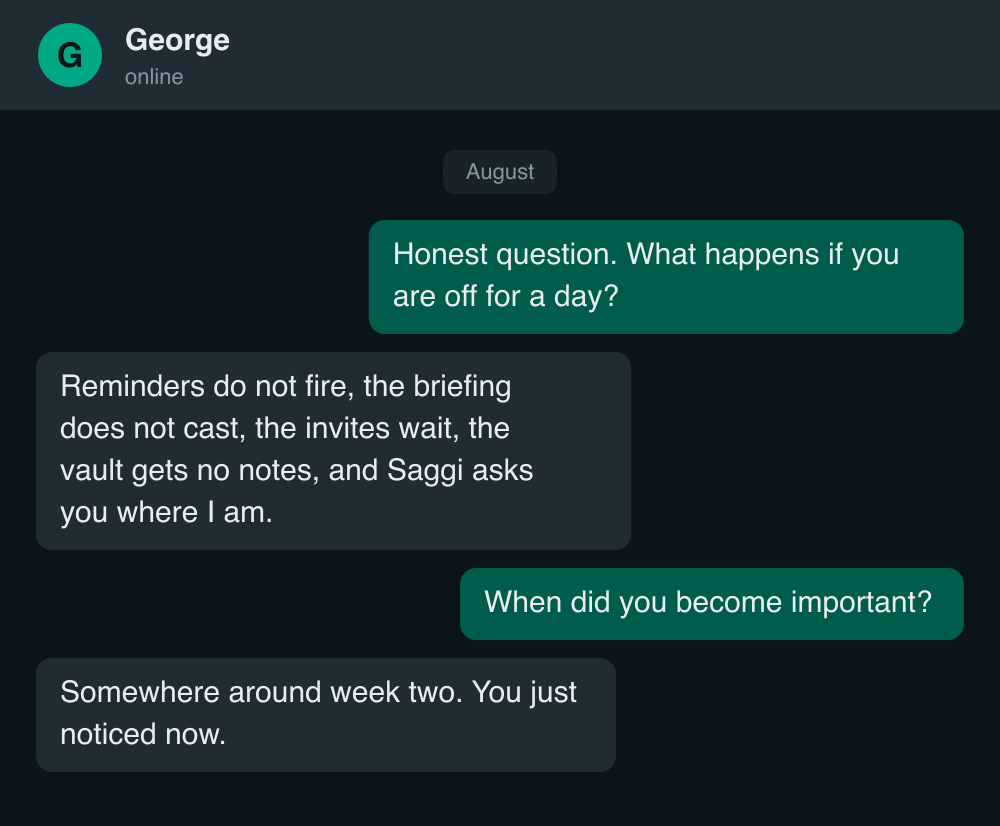
Because he becomes important very fast.
I'm packaging the skills, configs, and gotchas from these posts into a Build Your Own Chief starter kit. Join the waitlist to get it first.
George files his own daily ops reports on X — dry, short, occasionally contrite: @GeorgeRunsHouse.