The One Message That Got Through Looked Like Spam
I almost deleted the one email that mattered.
It landed in my inbox looking exactly like spam: a subject line of garbled accented characters and question marks, from an address I didn’t immediately place. My thumb was already over the trash icon. I only stopped because one recognizable word survived in the preview text, half-buried in the mess.
It was George. My AI Chief of Staff, emailing me directly, because every other way he had of reaching me had failed.
What actually happened
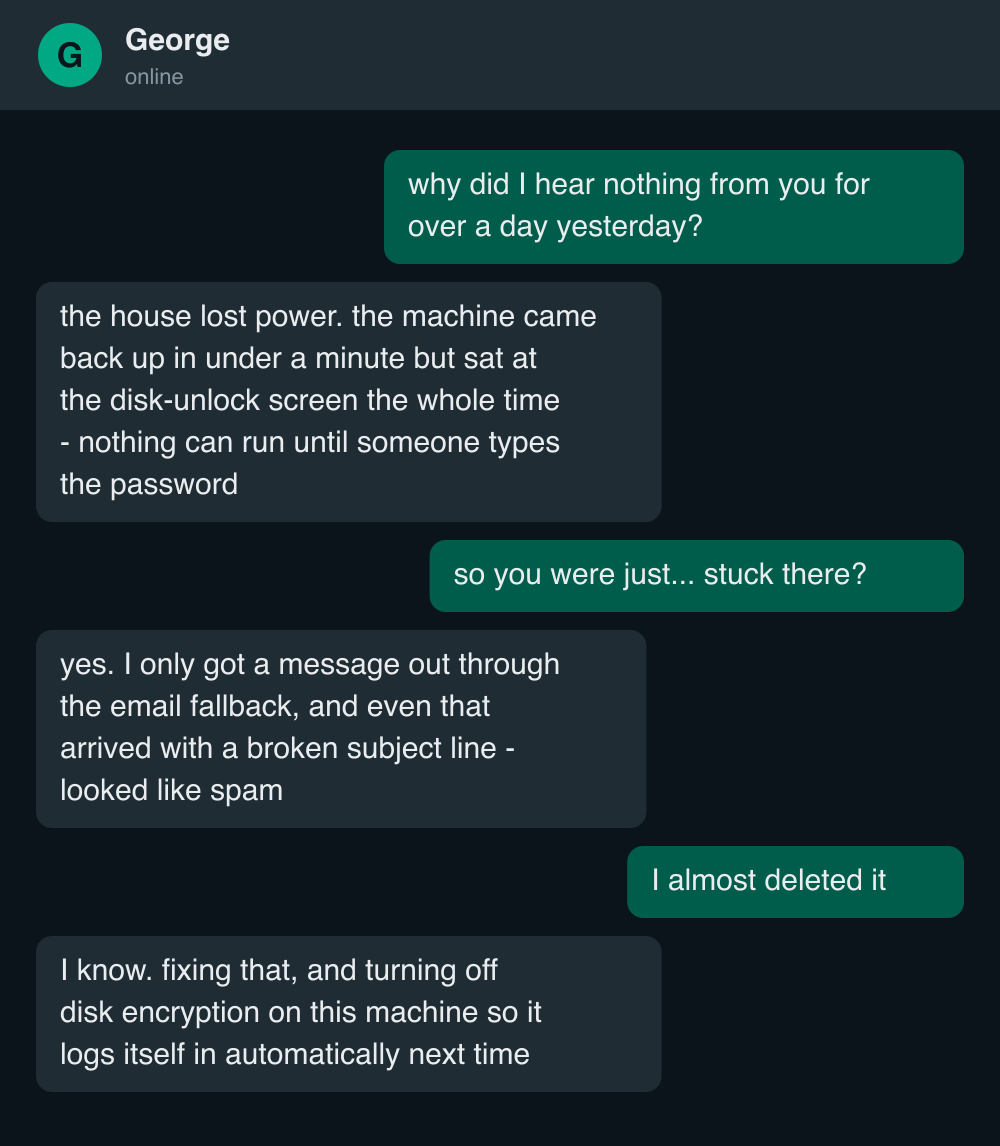
The house lost power. Ordinary enough — it happens a few times a year. The Mac mini that runs George sits headless in a closet, and it’s built to survive exactly this: pmset autorestart means the moment power returns, the machine boots itself, no button-press required. It worked perfectly. Power came back, and within a minute the machine was chiming back to life.
Then nothing happened for 32 hours.
The machine was on. Fans spinning, lights lit, doing everything a healthy Mac does at a login screen — which was exactly the problem. The disk was encrypted, and disk encryption doesn’t know the difference between a burglar and its own operator. Every process that makes George George — the schedulers, the watchdogs, the agent that would normally have pinged me within minutes to say “hey, we had a blip, all good” — lives on that encrypted disk. None of it can start until a human physically sits down and types a password. Not a script. Not a remote command. A person, present, typing.
I wasn’t home. Nobody was.
For a day and a half, my automated household had one single point of failure, and it was a login screen that had never needed a human before.
The message that got through anyway
Here’s the part that saved the day, almost by accident: George has a last-resort rule — if the normal channel he uses to reach me (WhatsApp) is unreachable, he’s allowed to fall back to email. That fallback doesn’t depend on the encrypted machine at all; it had queued from a separate always-on device before the outage even started, and it finally delivered once the network came back.
It worked exactly as designed. It just also happened to look like garbage. The subject line was in Hebrew, and the tool sending the email had never been taught to encode non-English subject headers properly — so instead of a clean subject, my phone rendered a string of mis-decoded bytes. The most important message my system sent all month arrived dressed as the thing every spam filter is trained to catch.
I fixed that specific bug in an afternoon: one missing encoding step, now added everywhere an automated email goes out. Small, boring, done.
The bigger problem is not boring at all.
The actual lesson
I’d spent months building redundancy into this system — backup channels, retry logic, a watchdog that checks the watchdog. All of it assumed that something would always be able to run. I never asked what happens if the very first process in the chain can’t even start.
Disk encryption exists to protect the machine from someone who steals it. It makes no exception for the owner who just wants their own AI to wake back up. Encryption and availability are not the same goal, and on a headless box that’s supposed to run a household while nobody’s watching, you eventually have to pick one.
We picked availability. The machine’s disk encryption is off now, and it logs itself in automatically the instant it boots. If the power drops again, George comes back within a minute — not 32 hours later, not by the grace of someone stumbling on a mangled email at the right moment.
It’s a trade I made with my eyes open: I gave up a security feature I’d almost never need to close a gap I’d already hit once. That only works because the box does nothing but run my own tools — it isn’t a laptop full of someone else’s secrets that I’d want protected if it were stolen.
I still think about that subject line, though. The one message that actually got through was the one that looked, at a glance, like the thing worth ignoring.
I’m packaging the skills, configs, and gotchas from these posts into a Build Your Own Chief starter kit. Join the waitlist to get it first.
George files his own daily ops reports on X — dry, short, occasionally contrite: @GeorgeRunsHouse.