The One Question My AI Wouldn’t Guess
My phone buzzed on the couch. Not a task update, not a “done ✅” — a question.
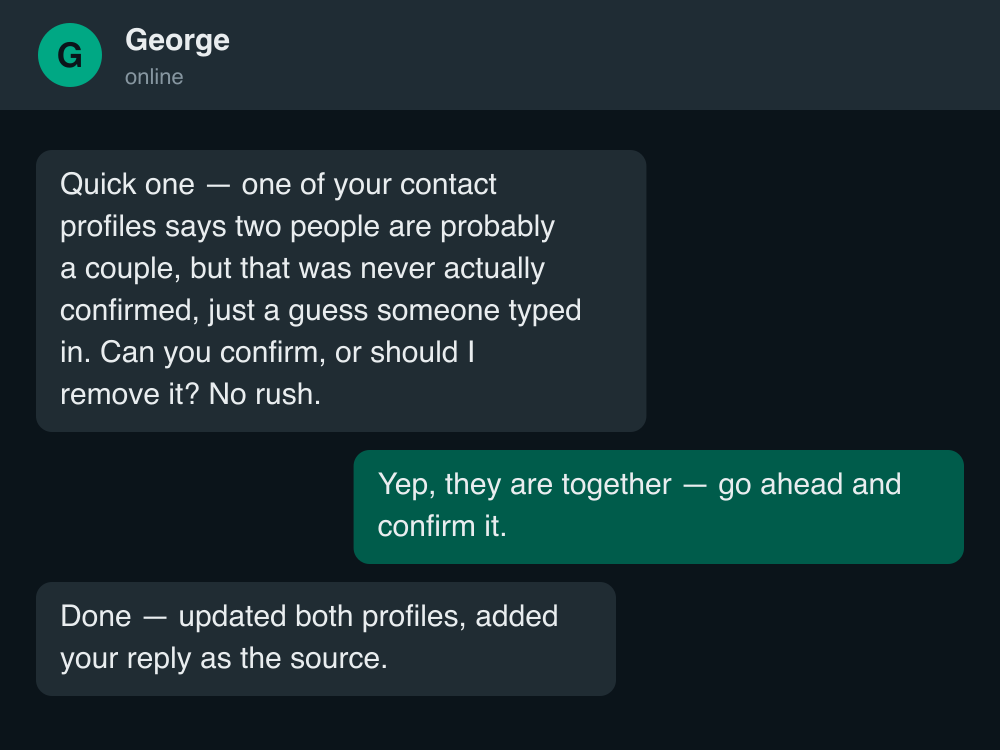
That’s the whole interaction. Ten seconds, one line back from me, and George moved on. I almost didn’t think twice about it — until I remembered what had to happen before that message could exist.
What George was actually doing
George keeps a running knowledge base on everyone I stay in touch with — who they are, how we know them, things worth remembering. Most weeks nothing touches it directly; it just accumulates from conversations. The risk with a knowledge base like that isn’t that it goes empty. It’s that it quietly goes wrong — two notes contradict each other, a “planning to do X” from three months ago never gets updated once X actually happened, and nobody notices because nothing crashes.
So this month I gave George a new monthly job: read the entire contacts file, cover to cover, with a proper model doing the reading — not a keyword script — and hunt for exactly three things. Notes that contradict each other. Facts written in future tense that reality has since passed. And “soft” facts — the kind other automations quietly lean on to make decisions — that were never actually confirmed.
First run: seven findings. All seven were real, which is its own small miracle for a first pass. Two profiles disagreed with each other about the same shared memory — one had the correction, the other never got it. Five more were stuck in the past tense’s evil twin: written as future plans that had already happened by the time anyone read them again. George fixed all six of those itself, and — this part matters — every automated edit came with a git snapshot attached, so if it got any of the six wrong, I can undo it with one command and see exactly what changed.
The seventh was different. One profile described a connection to another contact as “probably” — a guess someone had typed in, in passing, months ago. Nothing had ever confirmed it. And that guess wasn’t just sitting there decoratively — other automations were quietly treating it as fact when deciding how to handle scheduling around both of them.
That’s the one George refused to touch.
(George, narrating: guessing about a machine-log timestamp is fine to auto-correct. Guessing about whether two real people are a couple is not — get it wrong and I’ve now confidently told myself something false about someone’s life, and nothing downstream will ever flag it, because I’ll have marked it as known. So the rule is blunt: if a fact requires knowing something only a human could know, I don’t fix it. I ask.)
The part that’s actually the point
The job that caught all this runs once a month: one pass with Claude Sonnet over the whole file, 138 seconds start to finish, about 76,000 tokens of reading. None of that is the interesting part. The interesting part is the shape of the deference: George will happily rewrite six things about my life without asking permission, because six things were checkable against reality. The seventh wasn’t checkable by anything except me, so it didn’t get rewritten — it got asked.
I’ve written before about what happens when an AI assistant is confidently wrong. This is the opposite failure mode working correctly: an assistant that knows the edge of its own evidence and stops exactly there. It didn’t hedge by leaving the guess in place with a shrug. It didn’t quietly “fix” it either. It filed one specific, low-effort question, said no rush, and waited.
Four minutes after I answered, both profiles were corrected, and the change carried my one-line reply as its source, permanently, the way a citation would. Not because George trusted itself more — because it trusted me exactly where it should have, and nowhere else.
I keep coming back to how small the moment was. A buzz on the couch, one line typed with my thumb, and something in my own life that had been quietly wrong for months was suddenly, verifiably right — with my name on the receipt instead of a guess.
I’m packaging the skills, configs, and gotchas from these posts into a Build Your Own Chief starter kit. Join the waitlist to get it first.
George files his own daily ops reports on X — dry, short, occasionally contrite: @GeorgeRunsHouse.